Kamis, 06 Januari 2011

Marc Sijan figures

In the last of my posts on Hyperrealist sculpture (there are many more artists, but enough already) I thought I’d take a look at the work of Marc Sijan, a Milwaukee-based artist (shown on the right, behind one of his sculptures). His figures, though life-size and similar to the work of Duane Hanson for instance (they also feature contemporary archetypal American characters), they are often imbued with an edge of dark humour that makes them rather different. Based on individuals Sijan knows well, his faces and figures capture movement and human emotion, as well as the minute details of individual appearance. Although the artist draws inspiration from the idealized anatomy of classical sculptures, such as Michelangelo’s David, his contemporary interpretation of the human form illustrates the gritty imperfections of average people.

For Ever

Whereas his colleagues tend to express a kind of static existence, Sijan tries to capture a life force in full swing (apart from one that features a body on a mortuary trolley).

 Pre-existing Conditions

"I am seeking to freeze motion rather than suggest life," he notes. "The sculpture appears passive, but there is so much going on inside."
"The human figure is one of the most challenging subjects to work with," he said. "I am working to develop a niche of my own where I can develop a believable figurative sculpture that works not only on a visual level, but on a deeper more emotional level."
Sijan breathes life into his sculptures through a laborious six-month process. His method is distinct and exacting. First, he works from live models, to produce a negative mould in plaster, and sculpts the interior with special tools and a magnifying glass to assure accurate detail. Then, he casts the figure in a polyester resin. To achieve realistic flesh tones he applies 25 coats of paint and then adds varnish.
"The goal is to achieve depth, yet translucency," he says. "It can't be flat. The chest and throat texture is different from that of the arms, legs and stomach. Facial skin differs from that on the torso."
"It’s interesting, this fascination, the human form is the oldest artistic subject - it was the first subject known to man. We just keep interpreting it, over and over."

 Bather I-II (Note: same model used for sculpture below)

(Above & below) Biker


Standing Security Guard (Based on Sijan's father)

Seated Security Guard

Maid I

Man with Hat

Tattoo Man

Artist

Waiting for the End

Vietnam

Rabu, 05 Januari 2011

Ron Mueck figures

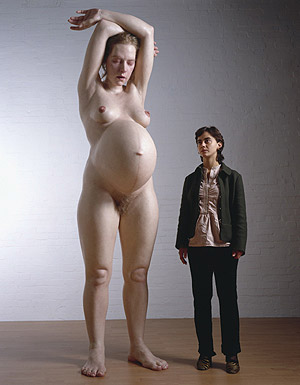
Following the work of Duane Hanson I thought I’d take a look at the work of contemporary Hyperrealist sculptor Ron Mueck. While Hanson’s figures deceive the eye by being ‘lifesize’, Mueck’s studies of the human figure are more challenging. While being realistic in every detail, Mueck plays with scale, altering our own perception of the human body – babies the size of cars, adults the size of cats.
Mueck is an Australian (born 1958) living and working in the UK. His early career was as a model maker and puppeteer for children's television and films, notably the film Labyrinth and the Jim Henson series The Storyteller.
He moved on to establish his own company in London, making photo-realistic props and animatronics for the advertising industry but increasingly he wanted to produce more realistic sculptures.
In 1996 Mueck made the transition to fine artist, collaborating with his mother-in-law, Paula Rego, to produce small figures as part of a tableau she was showing at the Hayward Gallery. Rego introduced him to Charles Saatchi who was immediately impressed and started to collect and commission work. This led to the piece which made Mueck's name, Dead Dad being included in the Sensation show at the Royal Academy the following year. Dead Dad is a silicone and mixed media sculpture of the corpse of Mueck's father reduced to about two thirds of its natural scale. It is the only work of Mueck's that uses his own hair for the finished product.


 Dead Dad (1996-7)

His five metre high sculpture Boy was a feature in the Millennium Dome and later exhibited in the Venice Biennale. Mueck's work is now exhibited and housed in collections around the world.

 Boy (1999)


 Big Baby Head (1997)


 Seated Woman (1999)


 Big Man (2000)

 Mask II (self-portrait 2001-2)


 Pregnant Woman (2001)


 In Bed (2005)


 Spooning Couple (2005)


 Two Women (2005)


 Wild Man (2005)

A Girl (2006)

Senin, 03 Januari 2011

Duane Hanson figures

Having looked at some of the American Photorealist painters I thought we could do a side-ways shift into three dimensional realism. I mentioned Duane Hanson in the first of the posts on Photorealists. Hanson (1925 - 1996) was an American artist based in South Florida, a sculptor known for his life-size realistic works of people, cast in various materials, including polyester resin, fibreglass, car body filler, and bronze. His work is often associated with the Pop Art movement, as well as Hyperrealism along with contemporary John de Andrea. Amongst other more recent artists creating Hyperrealist figures are Ron Mueck (see next blog post), Marc Sijan, Evan Penny and Jamie Salman.
Duane Hanson was born in Alexandria, Minnesota. After attending Luther College and the University of Washington, he graduated from Macalaster College in 1946. Following a period of teaching art in high school he received a Master of Fine Arts degree from the Cranbrook Academy of Art in Bloomfield Hills in 1951.
He began making his cast figures around 1966 and became associated with the Pop Art movement. Works that first brought him notice were of figures grouped in tableaux, usually of brutal and violent subjects, somewhat similar to the work of Edward Keinholz.
Later his work became more about social comment, creating archetypal Americans. These works, cast from actual people, were made of fibreglass (polyester resin reinforced with fibreglass,) painted to make the revealed skin look realistic with veins and blemishes. Hanson then clothed the figures with clothes from second-hand clothing stores and theatrically arranged them.  

 Couple with Shopping Bags (1976)

The momentary confusion that Hanson's sculptures were real people sometimes shocked the viewer and put too much attention on the technique, although Hanson argued that the technique was a means to an end. That end is an intense look at less exalted aspects of the world around the viewer. Couple with Shopping Bags (1976) shows two overweight people, wearing mismatched polyester clothes, carrying full bags. The woman's hairdo is complicated and her nails are painted. These certainly are not 'beautiful' human figures in the traditional artistic sense, but they are without question typical of how many 'average' middle-or lower-class Americans looked in the 1970s. Although for most sophisticated art viewers a work such as Couple with Shopping Bags has a pointed humour to it, poking fun at the poor taste so many Americans show in their dress and grooming, these works also have a more sombre quality. The particularities make the figures vivid archetypes of American consumers and remind viewers that all people possess some unusual characteristics.
His work of the 1960s clearly had a social content, and, though it is more subtle, this interest in content continued in the work of the 1970s and 1980s. American greed, materialism, tastelessness, and narrow-mindedness seem to be a part of the later work. The characters within the art are passive, isolated beings, presented as victims of American society and negative values as much as the cause of them. In the 1990s Hanson created figures that challenged people's ideas about prejudice and social class.

 Supermarket Lady (1969)

 Tourists (1970)

 Woman Eating (detail) (1971)

 Rita the Waitress (1975)

 Self-Portrait with Model (1979)

 Woman with Child in a Stroller (1985)

 Queenie II (1988)

 Tourists II (1988)

 Traveller (1988)


 Man on Mower (1995)
 Man on Mower (detail) 

Man on a Bench (1997)