My missus is a very talented artist and illustrator, creating incredibly finely detailed works painstakingly done with what looks like three hairs on a brush to me (mine look like Painter's and Decorators brushes by comparison).
Last night we went to the private view of an exhibition of original works by various artists who are working on a series of interactive story-telling cards for children called Storyworld. The exhibition is at a gallery called The Illustration Cupboard in Bury Street in the heart of the posh St. James gallery area in central London.
It's a small gallery and there was a sizable over-spill of seasoned illustrators and artists enjoying a catch-up and a glass of wine outside. Here are Pauline's illustrations from the series:
After the exhibition we went five yards across the road to Terence Conran's restaurant Quaglino's with our daughter Nina. It's a huge subterranean restaurant with a very chic ambience. Good service and good food rounded the evening off nicely.
Jumat, 20 Agustus 2010
Rabu, 18 Agustus 2010
Lloyd's Building
Following on from my recent post on the Pompidou Centre by architect Richard Rogers, I thought I'd have a look at his other iconic 'inside out' building, the London City landmark, the Lloyds Building.
Designed in the high-tech style by Rogers in 1979 it too has the unusual architectural approach of putting most of the building's services (staircases, lifts, air conditioning ducts, water pipes etc.) on the outside of the building.
The stainless steel 'spinal columns' that rise on the exterior are in fact spiral staircases.
Designed in the high-tech style by Rogers in 1979 it too has the unusual architectural approach of putting most of the building's services (staircases, lifts, air conditioning ducts, water pipes etc.) on the outside of the building.
The stainless steel 'spinal columns' that rise on the exterior are in fact spiral staircases.
Senin, 16 Agustus 2010
Anthony Green RA
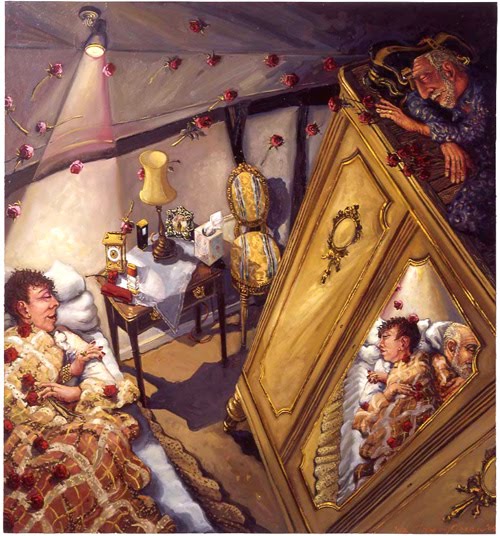
It seems appropriate somehow to follow my post on the portraits of Henri Rousseau with those of an old friend of mine, Royal Academician Anthony Green. Anyone who has been to visit the Royal Academy's Summer Exhibition in the last forty years can't have failed to have been struck by Anthony's highly personal portraits which are very frequently autobiographical, his subject matter almost always inspired by his relationships with his wife and family.
Anthony Green was born in 1939 and studied at the Slade School of Art, where he won the Henry Tonks Prize for drawing in 1960. This was followed by the Gulbenkian Purchase Award in 1963 and the Harkness Fellowship in the USA from 1967-69. He was elected to the Royal Academy in 1971. He is a Fellow of University College, London and serves as a Trustee of the Royal Academy.
He has experimented with irregular shaped compositions since 1966, which have on occasion progressed to freestanding 'sculptures' incorporating real objects as well as beautifully executed attention to detail. One of the most popular artists in the Royal Academy of Art Summer Exhibition each year, his paintings intrigue, amuse and enchant his many fans with their mood-enhancing sense of colour, humour and remarkable ability to capture life's events, both happy and sad, in a way that people readily identify with.
Anthony Green's work is included, among many other venues, in the public collections of the Tate Gallery, Setagaya Museum, Tokyo and the Metropolitan Museum of Art, New York. He has also exhibited internationally in London, New York, Berlin, Tokyo, Sidney, Chicago etc. He has had over 100 one-man shows since 1962.
Anthony Green was born in 1939 and studied at the Slade School of Art, where he won the Henry Tonks Prize for drawing in 1960. This was followed by the Gulbenkian Purchase Award in 1963 and the Harkness Fellowship in the USA from 1967-69. He was elected to the Royal Academy in 1971. He is a Fellow of University College, London and serves as a Trustee of the Royal Academy.
He has experimented with irregular shaped compositions since 1966, which have on occasion progressed to freestanding 'sculptures' incorporating real objects as well as beautifully executed attention to detail. One of the most popular artists in the Royal Academy of Art Summer Exhibition each year, his paintings intrigue, amuse and enchant his many fans with their mood-enhancing sense of colour, humour and remarkable ability to capture life's events, both happy and sad, in a way that people readily identify with.
Anthony Green's work is included, among many other venues, in the public collections of the Tate Gallery, Setagaya Museum, Tokyo and the Metropolitan Museum of Art, New York. He has also exhibited internationally in London, New York, Berlin, Tokyo, Sidney, Chicago etc. He has had over 100 one-man shows since 1962.
Jumat, 13 Agustus 2010
Henri Rousseau's portraits
I said in my last posting that I would follow up the naive painter Henri Rousseau's more famous jungle paintings with some portraits of his. Having started a few posts ago with some very modern minimalist portraits by Julian Opie, and then contrasting those with the more naive (faux naive?) style of Frida Kahlo's self portraits I thought I'd contrast those with one or two other painters' works.
The style of Rousseau's portraits are more traditionally what one associates with naive painting, and I like them a lot. I've always been a fan of early American naive painting and portraiture, and I would have to say that Frenchman Rousseau's work has a similar charm. The first one shown here is a self portrait.
Rabu, 11 Agustus 2010
Henri Rousseau's jungle paintings
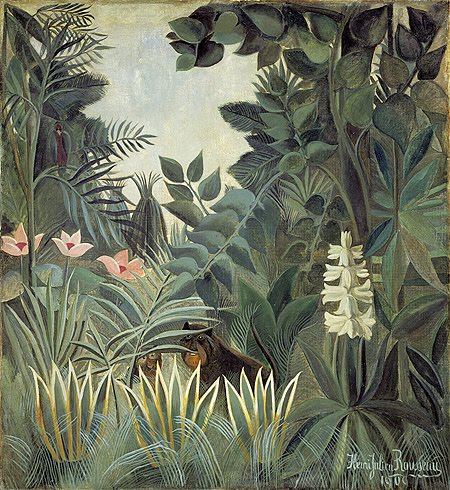
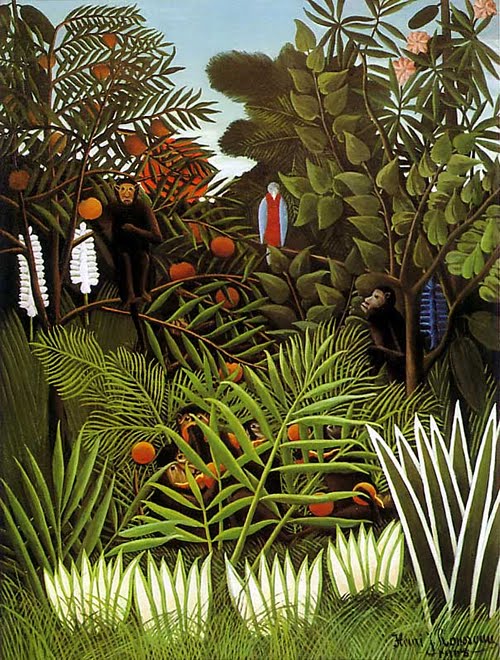
I'm returning to my mini-theme of portraiture by a roundabout route. In my next post I'll put up some portraits by the naive painter Henri Rousseau (1844–1910); but first I'm posting a different aspect of his work. Rousseau is far better known for some of the most popular and memorable paintings of the modern era. He is celebrated for his visionary jungle paintings that captivate the viewer with the lushness of their plant and animal life painted with incredible detail and precision. Extraordinarily the artist never saw the tropical scenes he brought so much to life, as he never left France. His exotic jungle paintings are the fantasies of a city dweller, constructed from visits to the zoo and botanical gardens, from postcards, books and from Rousseau’s vivid imagination. These jungles have intrigued people for decades, offering a dream of escape from humdrum reality to a savage and yet enchanting realm.
Rousseau’s unique vision was celebrated by his modernist contemporaries like Pablo Picasso and the surrealists René Magritte and Max Ernst, who saw his work as opening up new realms of artistic possibility. They were particularly fascinated by his bold, primitive style and the dream-like nature of his paintings. For a customs official who was self-taught and only took up painting full-time in retirement, this was an extraordinary accomplishment.
Senin, 09 Agustus 2010
Pakistani truck art
This post isn't meant to be flippant in the light of the stream of bad news that keeps coming from Pakistan. Now contending with the human disaster of the monsoon floods, and the seemingly endless reports of terrorist bombs in the larger cities of Pakistan might make it seem like a bad time to be looking at a lighter side of the nature of Pakistan, but I think it's a valid point.
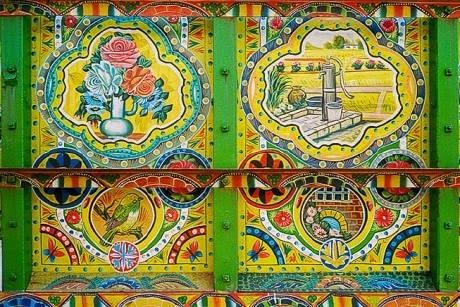
Pakistani truckers consider their vehicles as national symbols and make it a competition as to who has the most fabulous truck. Owners often spend over $3000 on paint and metal designs for their vehicles, which can be many times their monthly salary. Truck art started as a way to differentiate trucks in Pakistan from those in India after the countries split in 1947. Many of the treasured vehicles have an average age of 30 years and every part is replaced to keep the vehicle running as long as possible.
I love these painted vehicles, it's real folk art done with aplomb. I think there are many similarities with the old gypsy caravan painting and fairground art in this country. In Pakistan it's like the 60's and the Hippy trail never died.
Pakistani truckers consider their vehicles as national symbols and make it a competition as to who has the most fabulous truck. Owners often spend over $3000 on paint and metal designs for their vehicles, which can be many times their monthly salary. Truck art started as a way to differentiate trucks in Pakistan from those in India after the countries split in 1947. Many of the treasured vehicles have an average age of 30 years and every part is replaced to keep the vehicle running as long as possible.
I love these painted vehicles, it's real folk art done with aplomb. I think there are many similarities with the old gypsy caravan painting and fairground art in this country. In Pakistan it's like the 60's and the Hippy trail never died.
Langganan:
Postingan (Atom)