Selasa, 05 April 2011

Kurt Schwitters - collages

After showing my little collages I thought I'd take a look at the most famous famous exponent of the art, Kurt Schwitters. Schwitters (1887 – 1948) was born in Hannover, Germany. He attended the Kunstgewerbeschule in Hannover from 1908 to 1909 and from 1909 to 1914 studied at the Kunstakademie Dresden. After serving as a draftsman in the military in 1917, Schwitters experimented with Cubist and Expressionist styles. In 1918, he made his first collages and in 1919 invented the term “Merz,” which he was to apply to all his creative activities: poetry as well as collage and constructions. This year also marked the beginning of his friendships with Jean Arp and Raoul Hausmann. Schwitters’s earliest Merzbilder date from 1919, the year of his first exhibition at Der Sturm gallery, Berlin, and the first publication of his writings in the periodical Der Sturm. Schwitters showed at the Société Anonyme in New York in 1920.
With Arp, he attended the Kongress der Konstructivisten in Weimar in 1922. There Schwitters met Theo van Doesburg, whose De Stijl principles influenced his work. Schwitters’s Dada activities included his Merz-Matineen and Merz-Abende at which he presented his poetry. From 1923 to 1932, he published the magazine Merz. About 1923, the artist started to make his first Merzbau, a fantastic structure he built over a number of years; the Merzbau grew to occupy much of his Hannover studio.

The original Merzbau in Schwitter's Hannover studio

A contemporary reconstruction of the original Merzbau

During this period, he also worked in typography. Schwitters was included in the exhibition Abstrakte und surrealistische Malerei und Plastik at the Kunsthaus Zurich in 1929. The artist contributed to the Parisian review Cercle et Carré in 1930. In 1932 he joined the Paris-based Abstraction-Création group and wrote for their organ of the same name. He participated in the Cubism and Abstract Art and Fantastic Art, Dada, Surrealism exhibitions of 1936 at the Museum of Modern Art, New York.
The Nazi regime banned Schwitters’ work as ‘degenerate art’ in 1937. This year, the artist fled to Lysaker, Norway, where he constructed a second Merzbau. After the German invasion of Norway in 1940, Schwitters escaped to Great Britain, where he was interned for over a year.
He settled in London following his release, but moved to Little Langdale in the Lake District in 1945. There, helped by a stipend from the Museum of Modern Art, he began work on a third Merzbau in 1947. The project was left unfinished when Schwitters died in 1948 in Kendal, England.


Schwitters' London home at 39 Westmorland Road, Barnes.

 1919 Bild mit heller Mitte [Picture with Light Centre]

 1919 Das Undbild [The And-Picture]

 1919 Revolving

 1921 Merz 299

 1921 Merz 460 Two Underdrawers

 1922 Der Weihnachtsmann [Santa Claus]

 1922 Merz 410 irgendsowas [Something or Other]

 1922 Table Salt

 1923 Aphorism

 1923 Merz 231 Miss Blanche

Pausing here for a little comparison of the above collage with Peter Blake's 2005 silkscreen series of found art Cigarette Packs. From CCA Galleries: "Sir Peter Blake's found art cigarette packets or fag packets as they have come to be affectionately known. This series demonstrates Blake’s belief that beauty can be found anywhere, even in objects that most would believe to be rubbish. The fag packets highlight iconic 20th century design and branding, a key component in the pop art movement. The simplicity of these pieces adds to their wallpower.”


Peter Blake: 2005 Gigarette Packs [silkscreen]

1925 Elikan
1928 Untitled

1930 Oorlog

1937-38 Opened by Customs

1938 Die Fruhlingstur [The Spring Door]

1942-43 [Difficult]

1944 [Hitler Gang]

1947 The Holy Night by Antoni Allegri, known as Corregio, 
worked through by Kurt Schwitters]

Another view of the Merzbau reconstruction

Minggu, 03 April 2011

Recent work - collages

Thought I'd squeeze in a quick in-between post of a few collages I made recently.
A collage may include newspaper clippings, ribbons, bits of coloured or hand-made papers, portions of other artwork, photographs and other found objects, glued to a piece of paper or canvas. The origins of collage can be traced back hundreds of years, but this technique made a dramatic reappearance in the early 20th century as an art form of novelty.
The term collage derives from the French “colle” meaning “glue”.This term was coined by both Georges Braque and Pablo Picasso in the beginning of the 20th century when collage became a distinctive part of modern art.
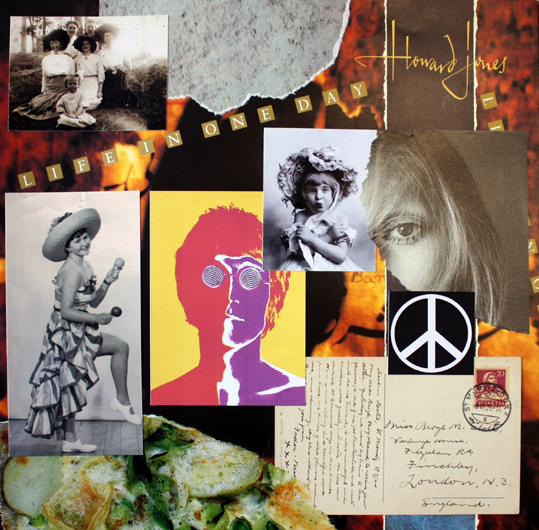
I had the idea of collaging onto charity shop finds of old 12-inch album covers - I've called the series For the Record. After trawling a number of charity shops for what I thought were 'suitable' covers for the idea, these are the results:

 If I Could Turn Back Time

 Life in One Day

 Music from the Films

 Sacrifice/Healing Hands

 Skellern  

 Spear of Destiny

Who's That Girl

Jumat, 01 April 2011

Jim Dine III – hearts

This is the third and last of three consecutive posts on pop artist Jim Dine - for biographical notes on Dine see Part I below.
“I always need to find some theme, some tangible subject matter besides the paint itself. Otherwise I would have been an abstract artist. I need that hook… something to hang my landscape on” Jim Dine in Jim Dine: Five Themes, 1984
Alan Cristea Gallery, London (2010): Such is Jim Dine’s importance that his work has been celebrated in solo exhibitions from the Guggenheim to the Getty in his native America and in museums in major cities across the length and breadth of Europe over the past 55 years. As he nears his 75th birthday, the demand for his work from institutions and collectors grows ever greater and he still exerts enormous influence over contemporary art practice both here in the UK and abroad.
The “Heart”, one of his most enduring vehicles for his explorations of line and colour and one of his most expressive motifs, will be the common denominator in some 40 recent works, made in his studios in New York and Gottingen, Germany, and on a recent journey to India, which we will exhibit in both of our Cork Street galleries in April and May.
Dine is the Renaissance man of contemporary art – originally performance artist, now at once poet, writer, photographer, sculptor, painter and printmaker.

 1982 Rancho Woodcut Heart

 1983 Black Heart (lithograph)

 1985 Two Big Black Hearts (bronze)

 1986 Hand Painting on the Mandala

 1993 Heart for Film Forum (woodcut)

 2007 Dear Senior Boy

 2008 Merry Snow

 2010 Black Friar's Blues

 2010 Blue Birds

 2010 Boo-Boo Blues

 2010 Manhatten at Home

 2010 Tools & Fire

 The Month of June no. 1

 The Month of June no.2

 The Month of June no. 3

 The Month of June no. 4

 The Month of June no. 6

 The Month of June no. 9

 The Month of June no. 10